Stamped Concrete in Brookfield, WI
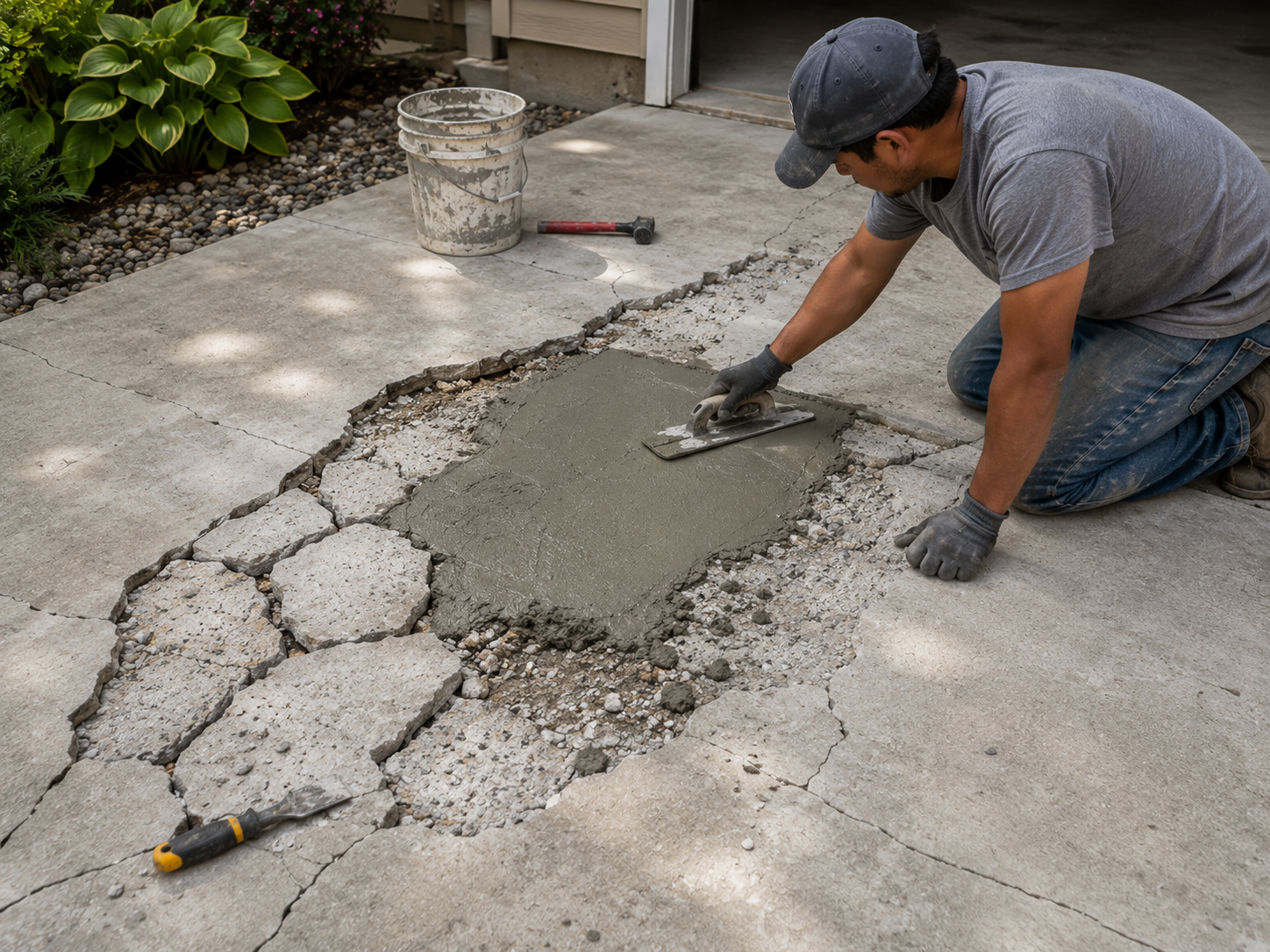
Professional Concrete Repair Services
Stamped Concrete in Brookfield, WI
Stamped concrete combines the strength and continuity of poured concrete with decorative patterns and color. It is commonly used when property owners want patios, walkways, entries, or other flatwork to have more visual character than a standard broom finish. Brookfield Concrete Guys provides a local point of contact for property owners planning stamped concrete, replacement, or related concrete improvements in Brookfield, Wisconsin.
Brookfield properties experience the full range of southeastern Wisconsin weather: freezing winters, spring moisture, summer heat, and repeated freeze-thaw cycles. Exterior concrete therefore benefits from thoughtful drainage, a stable base, appropriate jointing, air-entrained concrete where exposure conditions call for it, careful finishing, and proper curing. Site conditions vary from property to property, so thickness, reinforcement, base preparation, slope, mix requirements, and other details should be selected for the actual use and conditions rather than treated as one-size-fits-all.
Professional Stamped Concrete Services in Brookfield
A strong concrete project starts with understanding the site and intended use. Dimensions, grades, access, drainage, existing pavement, soil support, nearby structures, and finish expectations can all affect the recommended approach. Brookfield Concrete Guys can discuss new installations and replacement needs without relying on a generic detail for every property.
The finished surface is only the visible part of the work. Preparation below the slab, concrete selection, placement, jointing, curing, and protection during early strength development all contribute to performance. Customers should expect a contractor to discuss those fundamentals along with appearance and price.
Pattern, Color, and Border Choices
The goal is usually to complement the property rather than make the concrete look overly busy. Homeowners can coordinate colors with brick, stone veneer, siding, roofing, landscaping, or other hardscape materials. Borders can frame a patio, distinguish a walkway, or create a visual transition at an entry.
Samples are useful, but customers should understand that concrete is a natural-looking material with normal variation. Lighting, moisture, sealer, texture, batch conditions, and curing can all affect final appearance. Exact uniformity should not be expected in a hand-finished decorative surface.
Where Stamped Concrete Works Well
Popular applications include backyard patios, front walks, garden paths, pool-adjacent areas where appropriate, entry landings, porch surfaces, and decorative driveway accents. For areas exposed to vehicles, snowplows, heavy equipment, or frequent deicer use, the design and maintenance plan should reflect those demands.
Stamped surfaces have deeper texture than broom-finished flatwork. That texture can be visually attractive, but homeowners should consider snow removal, furniture stability, traction, and cleaning when selecting a pattern.
Call For a Quote:
(262) 932-9264
Sealing and Maintenance
Many stamped concrete systems are sealed to enhance color and provide surface protection. Sealers wear over time, particularly in traffic areas and Wisconsin weather, so periodic maintenance may be appropriate. The interval depends on the product, exposure, traffic, and desired appearance rather than a fixed calendar.
Winter care matters. Deicing chemicals and repeated freeze-thaw cycles can stress exterior concrete. New concrete deserves especially cautious winter treatment. Sand can provide traction without introducing aggressive chemicals.
Why Decorative Concrete Requires Skilled Timing
Stamping is time-sensitive. The crew must place and finish the slab, apply decorative materials, begin stamping at the correct firmness, maintain pattern alignment, work around edges, and complete the surface before the concrete becomes too hard. On larger placements, sequencing and crew coordination are important. A professional should also plan joints so that crack-control needs and decorative appearance work together.
Residential Stamped Concrete
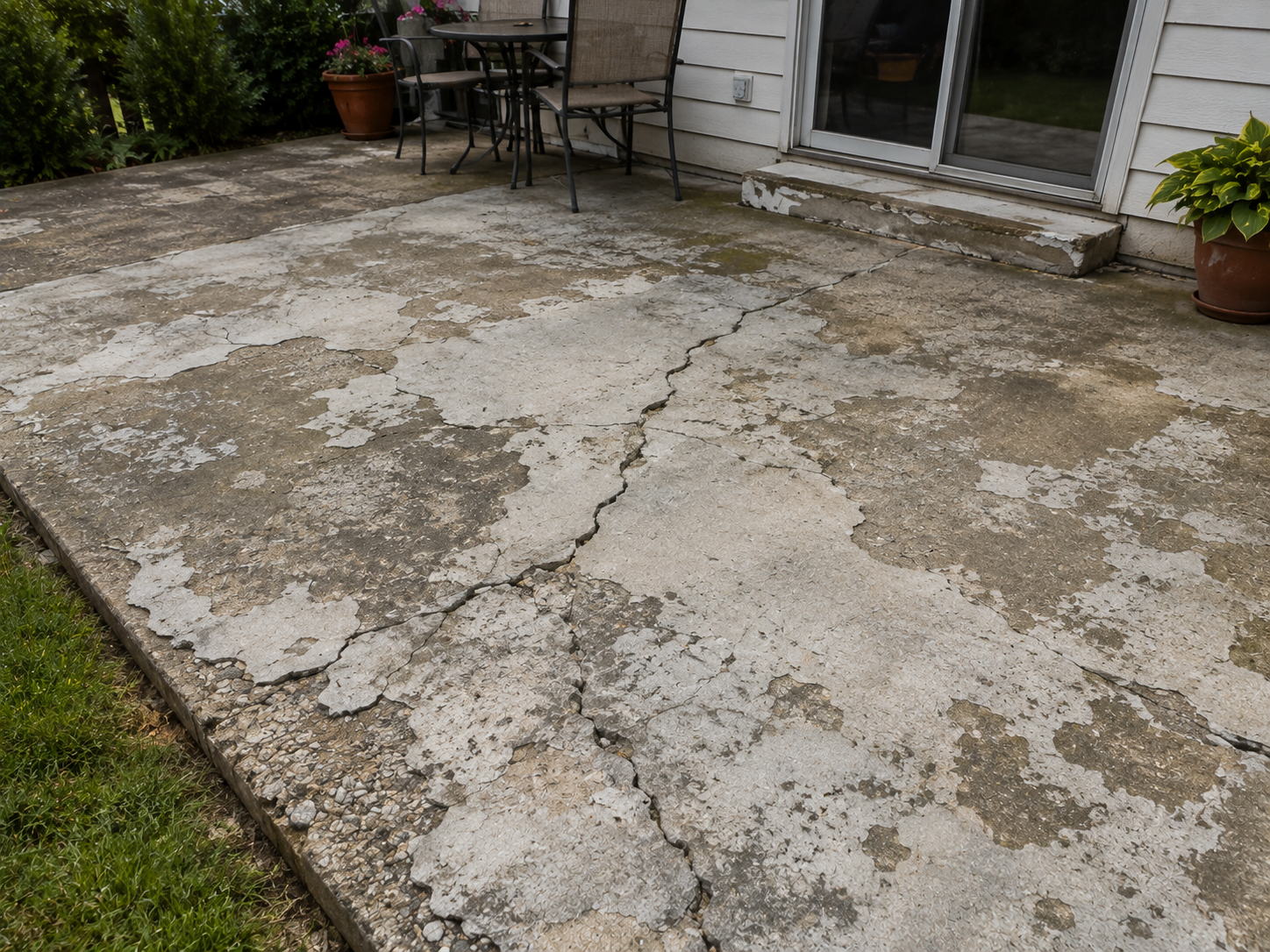
For homeowners, stamped concrete can improve daily use of the property while addressing worn, poorly drained, undersized, or outdated concrete. Residential planning should consider how family members and visitors move through the site, where snow is stored, how vehicles or furniture use the surface, and how the work connects to the home and landscaping.
Benefits of Professional Stamped Concrete
Professionally planned concrete work provides value through durability, usability, drainage control, and a finished appearance that suits the property. Concrete is versatile enough to serve pedestrian areas, vehicle surfaces, outdoor living spaces, utility areas, and structural-support applications when the slab is designed for the intended use.
For Brookfield properties, one of the biggest benefits is the ability to build around local weather demands. Exterior concrete can perform well in Wisconsin, but freeze-thaw exposure makes details such as air entrainment, curing, drainage, base support, and winter care important. A professional installation brings those details into the project from the beginning rather than treating them as afterthoughts.
Concrete also offers design flexibility. Dimensions, elevations, joint layouts, edge details, textures, and decorative finishes can be selected around the site. That makes it possible to solve practical problems while improving the way the property looks and functions.
Common Applications
Common applications for stamped concrete vary by property but may include new construction, replacement of worn concrete, additions to existing hardscape, repairs to localized damage, and upgrades that improve access or outdoor use. The right scope depends on what the surface must support and how it connects to surrounding improvements.
On established Brookfield properties, demolition and replacement may require working around mature landscaping, utilities, existing foundations, garage elevations, neighboring pavement, and limited equipment access. Those constraints should be identified before work starts.
Commercial Considerations
Where stamped concrete is used at a business, multi-unit property, office, or other commercial site, traffic and operational demands may be higher. Accessibility, public circulation, loading, scheduling, and code requirements can also become more significant. Project-specific requirements should be verified before construction.
Materials, Mixes, Reinforcement, and Finish Options
Concrete is a mixture of cementitious materials, water, fine and coarse aggregate, and often admixtures selected to adjust properties such as air content, workability, or setting characteristics. Exterior Wisconsin flatwork commonly benefits from air entrainment because microscopic air voids improve resistance to freeze-thaw exposure. The correct mix should be selected for the application and weather conditions rather than altered casually at the jobsite.
Reinforcement can take several forms. Reinforcing bars, welded wire reinforcement, or fibers may be used depending on the slab and design. Reinforcement is not a substitute for adequate thickness, stable support, or joints, and it does not make concrete crack-proof.
Finish choices range from broom textures to troweled interior surfaces and decorative treatments. The appropriate finish depends on location, traction, appearance, maintenance, and any future coating or flooring. Exterior surfaces should balance aesthetics with practical winter use.
A Typical Professional Stamped Concrete Process
Although every property is different, a well-organized concrete project usually follows a logical sequence. First comes a site review: dimensions, elevations, access, drainage, existing concrete, nearby structures, and intended use are discussed. The scope can then be defined so the estimate reflects demolition, excavation, base work, forming, reinforcement, concrete, finishing, cleanup, and any decorative or special requirements.
Preparation follows. Existing material is removed when necessary, unsuitable soils are addressed, and the subgrade or aggregate base is shaped and compacted. Forms establish edges and elevations. Reinforcement and embedded items are positioned when specified. Before placement, the crew should have a plan for truck access, weather, finishing sequence, joints, and curing.
During placement, concrete is discharged close to its final position, struck off, floated, edged, jointed, and finished at the appropriate times. Exterior flatwork is often broom textured for traction unless a decorative system is planned. Curing begins promptly after finishing because moisture and temperature control are essential to strength development and surface durability.
After placement, the new concrete needs protection from traffic and damaging weather. The time before walking, driving, loading, coating, or sealing varies with the project, conditions, and products used. Customers should follow the instructions provided for their particular installation.
Why Consider Brookfield Concrete Guys?
Brookfield Concrete Guys focuses this page on the questions local property owners should consider before investing in concrete sidewalks & walkways. The goal is to help customers evaluate the entire project - use, site preparation, drainage, appearance, durability, and maintenance - instead of treating concrete as a commodity purchased only by square footage.
Customers can contact Brookfield Concrete Guys to discuss a planned installation, replacement, or related concrete need in Brookfield. A project conversation can help clarify scope, identify related work that should be coordinated, and determine the next step toward an estimate.
No two sites are identical. Recommendations should be based on the actual property and intended use rather than unsupported promises about lifespan, crack-free performance, or a universal construction detail.
Concrete Work in Brookfield and Nearby Communities
Brookfield includes established residential neighborhoods, newer improvements, retail and office properties, and other developed sites where concrete must fit around existing buildings, landscaping, utilities, and drainage. Replacement work is common on mature properties because the new slab has to connect to fixed elevations and surrounding improvements.
Brookfield properties experience the full range of southeastern Wisconsin weather: freezing winters, spring moisture, summer heat, and repeated freeze-thaw cycles. Exterior concrete therefore benefits from thoughtful drainage, a stable base, appropriate jointing, air-entrained concrete where exposure conditions call for it, careful finishing, and proper curing. Site conditions vary from property to property, so thickness, reinforcement, base preparation, slope, mix requirements, and other details should be selected for the actual use and conditions rather than treated as one-size-fits-all.
Brookfield Concrete Guys is positioned to discuss projects in Brookfield and nearby communities in the greater Waukesha County and Milwaukee-area market, subject to project location and scheduling. For work outside Brookfield, customers should confirm service availability when requesting an estimate.
Why Professional Installation Matters
Concrete work is difficult to correct after the material has set. Problems with grade, slab thickness, joint placement, base preparation, drainage, or finishing can become permanent or expensive to change. The placement itself is also time-sensitive: once ready-mixed concrete arrives, the crew has a limited window to place and finish it properly.
An experienced contractor should be able to explain the proposed construction, not just quote a price per square foot. Useful discussions include excavation depth, base material, slab thickness, reinforcement, concrete mix, drainage, joint layout, finish, curing, demolition, disposal, access, and protection of adjacent property.
Price matters, but an unusually low proposal can be misleading if important work is excluded. Comparing written scopes helps property owners understand whether bids are truly comparable.
Choosing a Stamped Concrete Contractor in Brookfield, WI
Ask prospective contractors to describe what is included from preparation through cleanup. Find out how they approach drainage and base conditions, what slab thickness is proposed, how joints will be laid out, what finish will be used, and how the concrete will be cured. For decorative or specialized work, ask how color, texture, sealing, or future coatings affect the process.
It is also reasonable to discuss access, schedule, weather delays, protection of landscaping, demolition limits, and who is responsible for permits or inspections when they apply. Brookfield's municipal requirements can vary by project type, and work affecting structures or public right-of-way can involve additional rules. Property owners should verify requirements for their specific project.
A clear scope is one of the best tools for comparing contractors. It reduces surprises and helps ensure that everyone has the same expectations about the finished work.
Frequently Asked Questions
Is stamped concrete real concrete?
Yes. It is cast-in-place concrete that receives color and texture while the surface is workable.
Does stamped concrete need to be sealed?
Many decorative systems use sealer to enhance color and provide protection. Sealer selection and reapplication depend on the products, traffic, weather, and desired appearance.
Is stamped concrete slippery?
Texture and sealer influence traction. Exterior decorative surfaces should be selected with wet and winter conditions in mind, and slip-resistant additives may be appropriate with some sealers.
Can stamped concrete look like stone or brick?
Patterns can create the visual texture of slate, flagstone, cobblestone, brick, wood, and other materials, though it remains a poured concrete surface.
Will the color be perfectly uniform?
No. Normal variation can result from materials, finishing, curing, antiquing, sealer, moisture, and lighting. That variation is part of the character of decorative concrete.
Can stamped concrete crack?
Yes. Stamping does not change the basic shrinkage behavior of concrete. Proper joints, base preparation, curing, and slab design remain important.
How is stamped concrete maintained in Wisconsin?
Keep it clean, maintain sealer when appropriate, avoid aggressive deicers, and follow the installer or product manufacturer's winter-care guidance.
Can stamped concrete be used for steps and walkways?
Yes, provided the design addresses safe geometry, traction, drainage, and the specific exposure conditions.
Request an Estimate for Stamped Concrete in Brookfield, WI
If you are planning stamped concrete for a home, business, or other property in Brookfield, contact Brookfield Concrete Guys to discuss the project. Share what you want to build or replace, the condition of any existing concrete, and any concerns about drainage, access, appearance, or timing.
A good concrete project starts with a clear scope. Brookfield Concrete Guys can help you take the next step toward an estimate and a practical plan for your property.